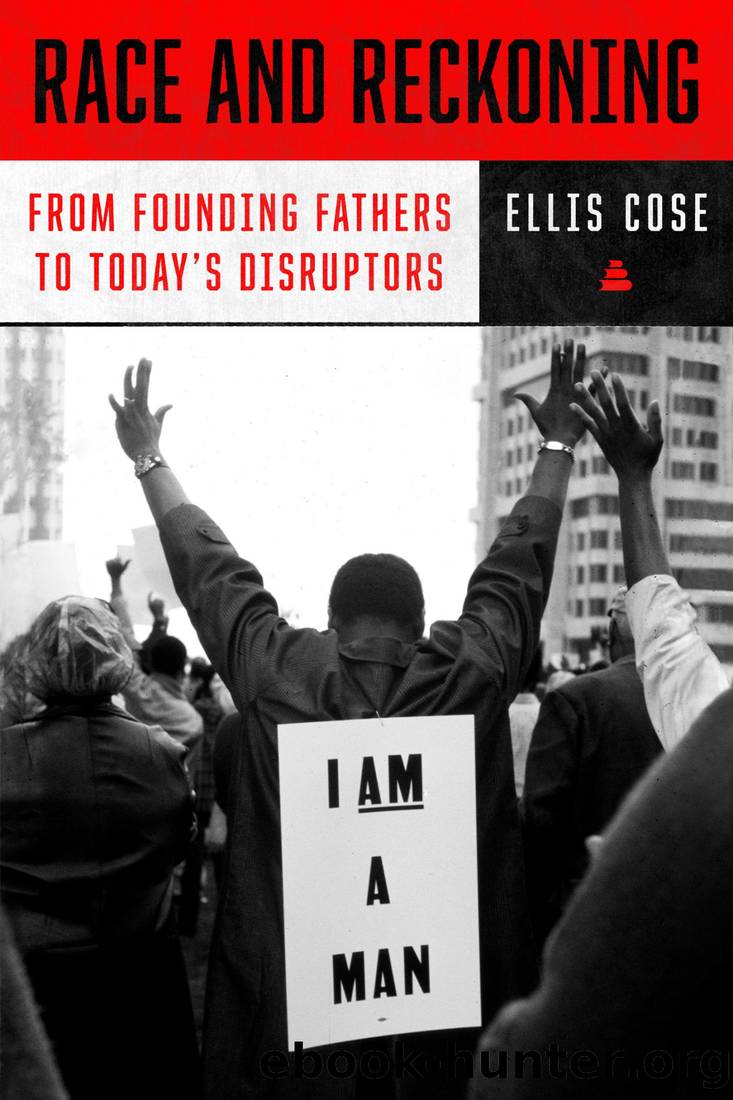
Race and Reckoning by Ellis Cose
Author:Ellis Cose [Cose, Ellis]
Language: eng
Format: epub
Published: 2022-06-07T00:00:00+00:00
9
Ending American Apartheid
In a fairer world, the civil rights movement would have been unnecessary, as Reconstruction would never have ended as it didâwith America giving responsibility for the welfare of âfreedmenâ to the very people who insisted that they had no rights, to the very people who had nearly wrecked the Union in a futile quest to keep human beings enslaved. But that fairer world was yet to be forged, and the questions that should have been long since resolved were deferred until after the Second World War.
With Nazis as the enemy, a reckoning had become inevitable. How could the worldâs leading nation, its only real superpower, resolve its own contradictions? In what moral universe was it possible to stand for both democracy and racially restricted voting, to support both equality and bigotry, due process and lynching?
Such questions were at the heart of the so-called Double V Campaign, which assumed that defeating homegrown racism was as important as defeating foreign fascism. That movement had been launched by a letter in January 1942 from James G. Thompson, a Pittsburgh Courier reader. Courier editors ran the letter on page 3 under a headline reading, âShould I Sacrifice to Live âHalf-American?ââ
Thompson made the point bluntly: âBeing an American of dark complexion and some 26 years, these questions flash through my mind: âShould I sacrifice my life to live half American?â âWill things be better for the next generation in the peace to follow?â âWould it be demanding too much to demand full citizenship rights in exchange for the sacrificing of my life?[â] Is the kind of America I know worth defending? Will America be a true and pure democracy after this war? Will Colored Americans suffer still the indignities that have been heaped upon them in the past?â
Thompson suggested that Americans aspire to a âdouble victory.â He noted that the âV for victoryâ sign was already on prominent display âin all so-called democratic countries which are fighting for victory over aggression, slavery and tyranny.â He suggested that âcolored Americans adopt the double VV for a double victory. The first V for victory over our enemies from without, the second V for victory over our enemies from within. For surely those who perpetrate these ugly prejudices here are seeking to destroy our democratic form of government just as surely as the Axis forces.â
The Courierâs readership rallied around Thompsonâs idea. Then the largest Black newspaper in America, the Courier reported being âinundated with hundreds of telegrams and letters of congratulations, proving that without an explanation, this slogan represents the true battle cry of colored America.â
Courier staff artist Wilbert L. Holloway developed the Double V insignia, which featured a graphic of one V atop another, along with the words DEMOCRACY, DOUBLE VICTORY, AT HOMEâABROAD. The newspaper enthusiastically took on the task of producing and distributing Double V pins, stickers, posters, and other paraphernalia aimed at driving home the irony, the insanity, of sacrificing US lives in the fight against racism and anti-Semitism abroad while brutally compelling apartheid at home.
Download
This site does not store any files on its server. We only index and link to content provided by other sites. Please contact the content providers to delete copyright contents if any and email us, we'll remove relevant links or contents immediately.
The Secret History by Donna Tartt(19086)
The Social Justice Warrior Handbook by Lisa De Pasquale(12190)
Thirteen Reasons Why by Jay Asher(8909)
This Is How You Lose Her by Junot Diaz(6886)
Weapons of Math Destruction by Cathy O'Neil(6279)
Zero to One by Peter Thiel(5801)
Beartown by Fredrik Backman(5754)
The Myth of the Strong Leader by Archie Brown(5507)
The Fire Next Time by James Baldwin(5442)
How Democracies Die by Steven Levitsky & Daniel Ziblatt(5218)
Promise Me, Dad by Joe Biden(5153)
Stone's Rules by Roger Stone(5087)
A Higher Loyalty: Truth, Lies, and Leadership by James Comey(4962)
100 Deadly Skills by Clint Emerson(4925)
Rise and Kill First by Ronen Bergman(4788)
Secrecy World by Jake Bernstein(4753)
The David Icke Guide to the Global Conspiracy (and how to end it) by David Icke(4717)
The Farm by Tom Rob Smith(4507)
The Doomsday Machine by Daniel Ellsberg(4490)
